Understanding Fence Post Replacement Cost: A Complete Guide
- William McKracherne
- Mar 13
- 10 min read


Finding a broken fence post is like spotting a loose shoe lace – you know it’ll trip you if you ignore it.
The cost to replace a fence post can swing wildly . One homeowner might pay $150 for a simple wood post and labor, while another who picks vinyl or metal could see $400‑$600. The biggest drivers are material, depth of the post, and if you need a permit.
First, check the damage. If the post is cracked or rotted, pull it out with a pry bar. Measure the hole – most standards call for a post set at least one‑third its length underground. Next, decide if you’ll DIY or hire a pro. DIY saves on labor but you’ll need tools, concrete mix, and a level. A pro handles digging, setting, and cleanup for a higher price tag.
Here’s a quick step list you can follow:
Inspect the post and note material.
Measure the existing hole or dig a new 2‑ft deep hole.
Choose a replacement material (wood, vinyl, steel).
Buy a post, concrete, and brackets – budget $30‑$80 per post.
Set the post, fill with concrete, and let cure 24‑48 hours.
Attach rails or panels and check for level.
If you’re unsure about the numbers, our Fence replacement guide breaks down material costs and common labor rates.
Don’t forget to factor in hidden costs: disposal of old wood, possible grading work, and local permit fees that can add $50‑$150.
When you plan your summer projects, you might also enjoy some fun reads like summer outfit ideas to stay cool while you work outside.
Step 1: Assess the Condition of Your Fence Posts
Knowing exactly what you’re dealing with saves time and money when you calculate fence post replacement cost. A bad post can drag the whole line down, so the first thing to do is a close look.
Start by walking the line and tapping each post with a hammer. If you hear a hollow thud or see wood that’s soft, splintered, or has visible rot, mark it. Check for cracks that run deep or metal that’s rusted through. Measure the exposed length and compare it to the hole depth – most codes ask for at least one-third of the post buried.
Once you’ve noted the problems, decide if the post can be repaired with a post‑leveler or if it needs a full swap. A full swap adds the cost of a new post, concrete, and labor, while a repair usually only adds a bracket and a few minutes of work. Remember, the deeper the hole, the more concrete you’ll pour, and that directly bumps the replacement cost.
Quick tip: write down each defect, snap a photo, and measure the hole before you call a pro. That list makes quotes clearer and helps you stay on budget.
Step 2: Choose Materials and Understand Their Cost Impact
Now that you know which posts need fixing, the next step is choosing the material. The material you pick has the biggest impact on fence post replacement cost.
Wood is the cheapest, a 4‑by‑4 treated post runs $10-$15 but will need a seal coat every few years. Vinyl costs $20-$30, won’t rot and keeps its colour, yet can crack in extreme cold. Steel tops out at $30-$45, offers the most strength and lasts longest, though a rust‑proof coating is wise near salty air.
If the fence only marks a garden edge, wood may be fine. For a security fence that faces wind or heavy use, steel’s extra cost can pay off.
Add the post price, about $5 per bag of concrete, and $2-$4 for brackets. Total these numbers and you’ll see a clear fence post replacement cost estimate. For more on material pricing, see our detailed fence replacement guide.
Quick tip: write down the per‑post cost, multiply by the number of posts, add $5-$10 for concrete each, and compare that total to any contractor quote.
Step 3: Calculate Labor Costs and Hiring Options
Now you have the material price. Next, figure out what labor will add to your fence post replacement cost.
If you DIY, you only pay for your time and a few tools. A basic post‑dig kit or a small auger runs $20‑$40. Add $5‑$10 for a level and a wheelbarrow if you don’t already own them. Most homeowners spend about $30‑$60 in supplies per post.
If hiring a pro usually means an hourly rate of $45‑$80 plus a small markup for materials. For a single post, expect $70‑$120 total. If you have five posts, the labor side can climb to $350‑$600.
Tip: get three written quotes. Write down each line – labor, concrete, cleanup – and compare it to your DIY total. The cheapest quote isn’t always the best; look for clear breakdowns and no hidden fees.
Wondering when a pro makes sense? If the ground is rocky, the hole needs to be deeper than three feet, or you lack a truck, a contractor can save you headaches.
One practical way to cut costs is to do the digging yourself and let a pro set the post and pour the concrete. That splits the labor bill and still gives you a professional finish.
Need more help planning your budget? Check out our fence repair guide for a step‑by‑step cost checklist.
Step 4: Estimate Total Project Cost – Comparison Table
Now that you know material and labor, it’s time to line up the numbers.
Below is a quick side‑by‑side view of the three most common ways to pay for a fence post replacement.
Method | Cost Range | What’s Included |
DIY | $30‑$120 per post | Tools, concrete, your time |
Hybrid | $80‑$150 per post | You dig, pro sets and pours concrete |
Full Pro | $120‑$250 per post | Dig, set, concrete, cleanup |
Take a look at the table. For each method, write down the numbers that match your project size. Multiply the per‑post cost by the number of posts you need. Then add a small buffer for permits or disposal.
Full cost guide
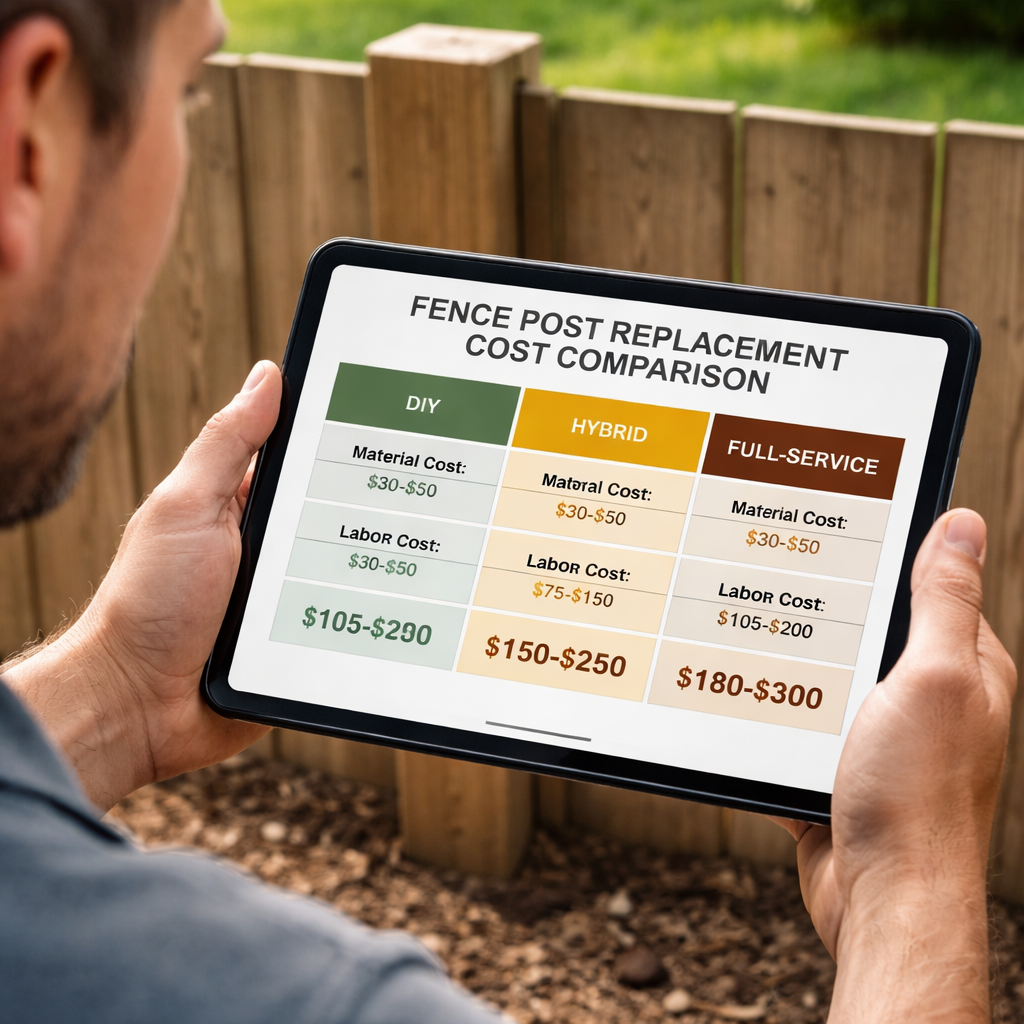
A DIY job saves money but costs time. A hybrid split cuts the biggest labor chunk while still letting you handle the digging. A full‑service hire gives you a clean finish with no sweat.
Remember to ask each quote for a line‑item breakdown so you can swap numbers into the table and see the true difference.
Don’t forget hidden fees like trash pickup, site cleanup, or local permit charges. Those can add $50‑$150, so pad your budget a little.
When the numbers line up, you’ll know exactly how much the whole project will run and can pick the option that feels right for your wallet and schedule.
Step 5: DIY vs. Professional Replacement – Cost‑Benefit Analysis
You’ve seen the numbers. Now it’s time to ask what matters more: cash or time.
If you go DIY, you keep the per‑post price low, but you also take on the hours of digging, mixing concrete, and aligning the post. For many, that adds 2–4 hours per post.
A pro handles all that work in a day or two, but the bill jumps to $80‑$250 per post. The real question is whether the time you save is worth the extra dollars.
Do a quick cost‑benefit check. Multiply the DIY per‑post cost by the number of posts, then add your estimated labor hours multiplied by a reasonable hourly rate—say $30‑$45. Compare that total to the pro quote. For a deeper look at all the cost factors, check out the full fence replacement cost guide.
Don’t forget hidden items. A DIY job may need extra concrete, trash pickup, or a permit, each tacking on $20‑$50. A pro often rolls those into the price, but ask for a line‑item list.
If you’re comfortable with tools and have a truck, the DIY route can shave $100‑$300 off a small fence. If the ground is rocky or you lack equipment, the pro option reduces stress and the chance of a crooked post.
Either way, write the numbers in a simple table. Seeing the total side by side makes the choice clear.
Step 6: Money‑Saving Tips and Tricks
Now that you’ve crunched the numbers, it’s time to shave off any extra cost.
First tip: buy the concrete and brackets in bulk. A 5-bag bag of mix costs less per bag when you get a 25-bag sack. Same with metal brackets, a pack of 20 saves you a few bucks compared to buying one at a time.
Second tip: reuse what you already have. If the old post is still solid, you can cut it down and use it as a brace or as a temporary marker while the new one sets. That cuts material waste and saves cash.
Third tip: check if your town offers a permit discount for DIY projects. Some municipalities waive part of the fee if you file the paperwork yourself. A quick call can shave $20-$40 off the total.
Fourth tip: rent tools instead of buying. A small auger or post-hole digger can be rented for a day at $15-$30. You avoid the upfront purchase price and still get the right tool.
Finally, keep a simple spreadsheet. List each expense, mark the ones you’ve reduced, and watch the total drop. You can also see budget-friendly material buying tips in our deck board replacement cost guide. When the numbers look right, you’ll feel good about the savings.
Step 7: Regional Price Variations and Permit Considerations
Prices for fence post replacement cost can jump a lot from one county to the next. First, call your local building office and ask for the current permit fee. Some towns charge $50, others waive it if you file the paperwork yourself.
Next, look at material costs in nearby stores. A 4‑by‑4 wood post might be $12 in the city but $9 in a rural supplier. Write those numbers down so you can see the spread.
Check for discounts
Many municipalities offer a DIY discount for residents who handle the dig themselves. Ask if a reduced rate applies when you show proof of insurance or a signed contractor waiver.
Factor travel time
If the nearest hardware store is far, add the cost of gas and your time. A quick spreadsheet can turn a $5 material saving into a $15 net loss once you count the drive.
Finally, keep a simple checklist: permit fee, material price, travel cost, any local discount. Compare the total to the estimate you got from a pro. If the gap is small, hiring a contractor may still save you hassle.
For a deeper look at how regional pricing can shift your budget, see our regional price guide for exterior projects.
Conclusion
You've seen how material, labor, permits and region shape the fence post replacement cost.
Pick the material that fits your budget and how much upkeep you want. Wood stays cheap, steel lasts long, composite sits in the middle.
Get a line‑item quote, check local labor rates and ask about permit fees before you sign.
DIY can shave the labor bill, but only if you have the tools, time and a safe site. If you’re unsure, a pro can keep the project on track and avoid hidden re‑work.
One last tip: keep a simple checklist of post type, depth, labor rate and permit cost. Update it as you collect quotes, then compare the totals.
When you’re ready to lock in a price, LGFMH Construction can handle the install so you don’t have to worry about surprises.
FAQ
What factors most influence the fence post replacement cost?
Material, labor, and local rates are the three big drivers. A cheap pine post will cost far less than a steel or composite one, but it may need more upkeep. The deeper the hole, the more concrete you’ll use, which adds to the bill. Finally, cities charge higher crew wages than small towns, so your zip code can swing the total by dozens of dollars.
How much does a typical wood fence post cost, including material and labor?
Wood posts usually run $30‑$45 each at the store. Add a bag of concrete ($5‑$10) and a couple of brackets, and you’re looking at $40‑$55 per post in material. If you hire a crew, labor can add $30‑$50 per foot of fence, which for a typical 8‑foot span works out to about $240‑$400 per post. Expect the full cost to sit between $280 and $455 per post when you factor in both parts.
Do I need a permit to replace fence posts in my city?
Most towns require a permit if the fence is higher than four feet or runs along a property line. The fee can be a flat $50 or a small percentage of the total job, usually under $150. Call your city’s building department and ask for the exact threshold; some places waive the charge for DIY jobs under a certain length. Getting the paperwork early saves you a surprise bill later.
Can I realistically cut the fence post replacement cost by doing the work myself?
Doing it yourself removes the labor line item, which can be half the total price. You’ll still need to buy the post, concrete, and any brackets, and you’ll spend time digging and setting each hole. If you have the right tools and a safe site, you can shave $200‑$500 off a typical project. Just be honest about the time you’ll need – your own hours have a cost too.
How does the cost of labor change between urban and rural areas?
Urban crews often charge $30‑$50 per foot, while rural rates hover around $20‑$35. The difference comes from higher living costs, insurance, and demand in cities. That gap can add up fast on a long fence; a 200‑foot job might cost $2,000 more in a big town than in a small county. Ask for a line‑item quote so you can compare apples to apples.
What hidden expenses should I budget for when planning a fence post replacement?
Beyond the post and labor, look for disposal fees for old wood, grading or soil‑stabilization costs, and any required permits. You might also need extra concrete if the ground is soft, or a metal sleeve if you’re re‑using a rotted post. A quick call to your local hardware store can reveal rental fees for a post‑hole digger, which can be $30‑$50 a day. If you’d rather avoid the hassle, LGFMH Construction can handle the install and take care of permits.


Comments