Understanding Gutter Guard Installation Cost: A Complete 2026 Guide
- William McKracherne
- Mar 13
- 8 min read

Finding the right price for gutter guard installation can feel like hunting for a needle in a haystack.
Most homeowners see a big price tag and wonder if it’s worth the cash. The truth? You’ll pay for the guard itself, the labor, and any prep work like fixing sagging gutters first. A common mistake is to skip the prep and end up paying extra later.
Here’s a quick way to break it down: start by measuring the linear footage of your roof edge, then check the material cost per foot—mesh, foam, or metal. Add about $50‑$100 per hour for pro labor. If you need to replace a few downspouts, that can add another $150‑$300.
Imagine you have a 200‑foot roof. Using a mid‑range metal guard at $2 per foot, the material runs $400. Labor for a two‑hour install adds $200. Total? Roughly $600, plus any extra repairs. That simple math helps you set a budget before you call anyone.
One practical tip is to ask for a written quote that separates material, labor, and prep costs. That way you can see where you might save—maybe by handling minor repairs yourself.
If you’re already planning exterior upgrades, pairing your gutter guard job with a trusted outdoor lighting installer can boost curb appeal and keep your home safe at night.
For a deeper look at what drives gutter costs, check out our guide on how seamless gutter installation cost works and what influences it and what influences it.
Understanding What Affects Gutter Guard Installation Cost
The price you see on a quote is only part of the story. It hides a few hidden bits that can add up fast.
First, look at the material. Mesh, foam, and metal each have a base price per foot. Metal tends to sit in the middle, foam can be cheap but may need more upkeep, and mesh is often the priciest but lasts longer.
Second, think about labor. Most pros charge by the hour, and the rate can jump if the roof is steep or hard to reach. If you have a two‑story home, expect a higher hourly rate than a single‑story house.
Third, prep work can be a silent driver. Fixing sagging gutters, clearing debris, or replacing a broken downspout all add to the total. Skipping these steps now often means paying more later.
Another factor is location. In areas where permits are required, you might pay a small fee for paperwork. Some neighborhoods also have HOA rules that dictate which guard types you can use.
Here’s a quick tip: ask for a line‑item quote. When you see each cost broken out, you can spot where you might save, like doing a simple clean‑up yourself.
Finally, remember that a solid guard is an investment. Spending a bit more on a durable material or proper prep can keep you from pricey repairs down the road.
Choosing the Right Gutter Guard Type and Typical Price Ranges
Not all gutter guards are created equal, and the price gap can be huge. Picking the wrong type can waste money and still let leaves slip through.
Mesh, foam, and metal basics
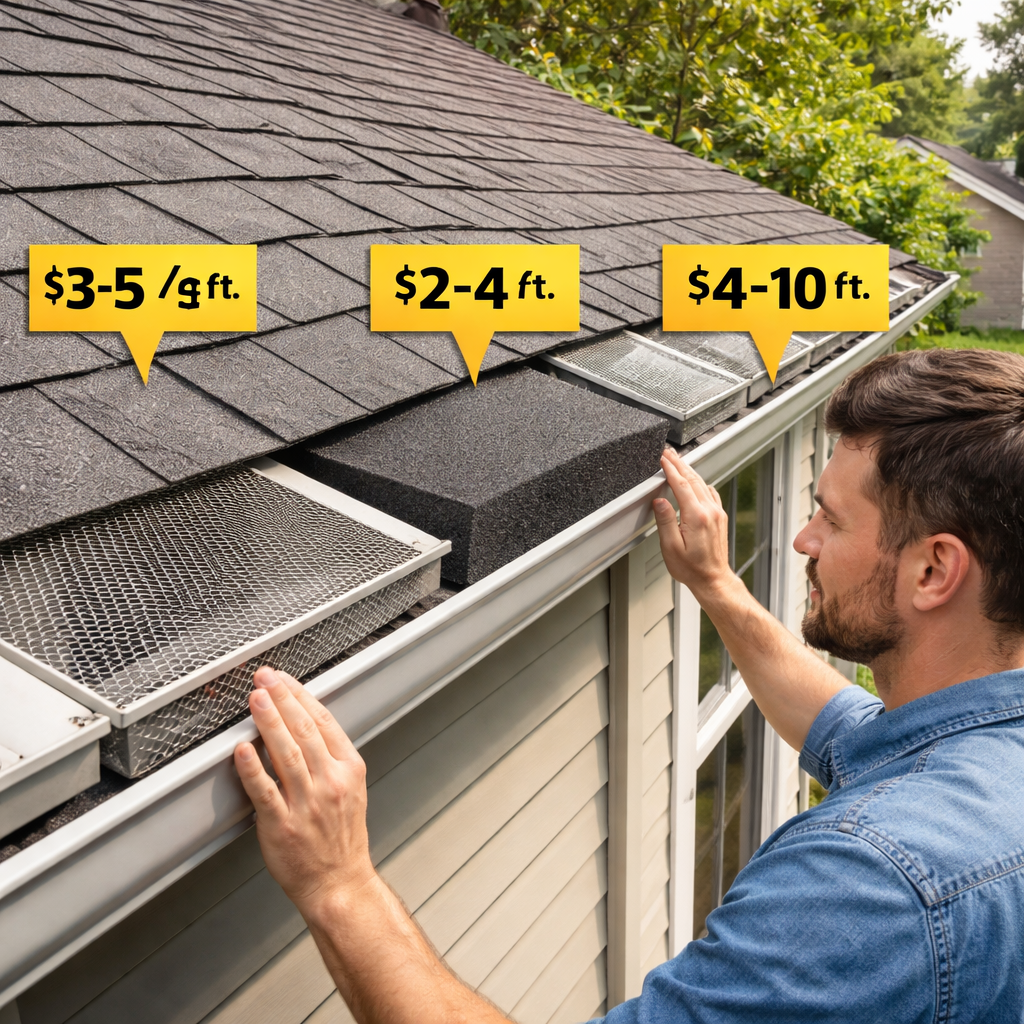
Mesh screens sit at the low end. They’re cheap, usually $1‑$2 per foot, but tiny debris can still clog them. Foam panels cost a bit more, around $2‑$3 per foot. They block bigger bits but may need replacement sooner. Metal guards sit at the high end, $3‑$5 per foot, and they last the longest.
Typical price ranges
For a 150‑foot roof, expect to pay roughly $150‑$300 for mesh, $300‑$450 for foam, and $450‑$750 for metal. Those numbers cover material only; labor adds $50‑$100 per hour, often 2‑3 hours for most homes.
So how do you know which option fits your budget? Think about how many trees line your yard, how steep your roof is, and how much you want to spend now versus later.
Climate matters too. In windy or leafy neighborhoods, a sturdier metal guard or extra fasteners can save you a future service call. In dry, low‑debris areas, a simple mesh may be enough and keep costs down.
Remember, the guard’s price isn’t the whole story. A cheap guard that clogs often can lead to higher cleaning bills, while a pricier model may pay for itself over years.
If you want to see how these costs stack up against the total gutter system, check out the guide on how seamless gutter installation cost works and what influences it. It breaks down labor, prep, and material so you can budget with confidence.
DIY Installation vs Hiring a Professional: Cost Breakdown
You can save a few hundred bucks by doing the guard yourself, but you also take on the time and risk.
A DIY install usually costs only the material plus a few tools. For mesh, you might pay $1‑$2 per foot, so a 150‑foot run is $150‑$300. Add $50‑$100 for a rental ladder or a basic screwdriver set, and you’re looking at under $400 total.
A pro will charge labor at $50‑$100 per hour. Most roofs need two to three hours, so labor alone adds $100‑$300. That pushes a mesh job to $250‑$600, and a metal guard to $600‑$1,050.
Don’t forget prep work. If your gutters are sagging or rusted, a contractor will fix that for an extra $150‑$300. You could handle minor repairs yourself for $30‑$60 in supplies, but a big fix might still need a pro.
Safety is another hidden cost. Climbing a steep roof without proper gear can lead to injury. A professional already has the harness, ladder, and insurance, which you’d otherwise have to buy or risk.
So how to decide? List the material price, estimate your tool cost, add any repair dollars, then compare that sum to the quoted labor plus prep. If the DIY total is $400‑$500 and the pro quote is $700‑$1,200, the savings are clear—but only if you feel comfortable on the roof.
For a detailed walk‑through, see our step‑by‑step guide to gutter splash guard installation.
Comparing Gutter Guard Costs by Material and Brand
When you compare gutter guard options, the price gap is real.
Three main material types dominate the market: mesh, foam, and metal. Each comes with a typical price range per linear foot and a set of brand choices that can shift the total.
Material | Cost per foot | Typical brand range |
Mesh | $1-$2 | Basic to mid-range |
Foam | $2-$3 | Mid-range to premium |
Metal | $3-$5 | Premium to high-end |
Brands that sell mesh guards often promise easy DIY install. Foam brands market durability against wind and bugs. Metal brands push long life and low maintenance.
So how does this affect your gutter guard installation cost? A 150-foot run of mesh might add $150-$300 to material. The same length in foam bumps it to $300-$450. Metal can push the material bill to $450-$750. Labor stays the same, so the material choice drives most of the price swing.
If you’re tight on cash, start with mesh and plan to replace it in a few years. If you hate cleaning, the higher metal cost may pay off fast.
When you weigh brand reputation, look for warranties that cover at least five years. A solid warranty can lower the hidden cost of future repairs. Many homeowners also check online reviews for fit issues, especially with metal guards that need precise brackets. By matching the material cost with a trusted brand, you keep the overall gutter guard installation cost in check.
For a full picture of how gutter cleaning expenses add up, see the guide on average gutter cleaning cost.
Maintenance, Repairs, and Hidden Expenses Over Time
Even after you pay for the guard, costs can still sneak up on you. A guard that looks fine today may need a fix in a few years.
Common repairs include broken brackets, rusted clips, or a warped screen that lets leaves slip through. Fixing a bracket can run $30 to $70 for parts plus a short labor call. Replacing a rusted clip may be $20 to $50. If the whole guard warps you might pay $150 to $300 to swap it out.
Check the warranty before you sign. Many brands cover five years of rust repair or bracket breakage. A good warranty can save you $200 to $400 in hidden costs over the life of the guard.
Hidden expenses often hide in the cleaning bill. A mesh guard may need a brush every spring, adding $50 to $100 to your yearly budget. Foam can attract bugs that chew the material, leading to a $100 to $200 replacement after a few seasons. Metal lasts longer, but if the roof is steep you may pay extra for special fasteners.
One practical tip is to add a “maintenance reserve” of about 5 to 10 % of the original guard cost each year. That way you have cash ready for a part swap or a pro cleaning without surprise.
Plan ahead and set a reminder for a quick check after each big storm. If you want step‑by‑step advice on keeping your guard in shape, read the guide on gutter guard upkeep.
Conclusion
You've seen how material, labor, and hidden upkeep shape the gutter guard installation cost.
Bottom line: a clear, itemized quote lets you spot where you can save. Add a line for yearly cleaning and a small budget for rust checks, then watch the numbers line up.
If you prefer a hands off approach, a pro can handle prep, install, and warranty for one price. If you like a DIY challenge, the same guard will cost less but ask for your time and a few tools.
One practical step: write down each cost piece in a simple spreadsheet the day you get a quote. When the total hits your break even goal, you know the guard is worth it.
Ready to lock down a fair gutter guard installation cost? Reach out to LGFMH Construction for an itemized estimate and a quick inspection.
FAQ
What factors affect gutter guard installation cost?
Material, labor, and prep work are the three big drivers of gutter guard installation cost. The type of guard you pick, foam, mesh, or metal, sets the material price per foot. Labor depends on how long the crew works and if they need to fix sagging gutters or replace brackets. Any repair or cleanup before install adds extra dollars. Knowing each piece helps you spot where you can save.
How much does material cost per foot?
Foam inserts run about $0.50-$1 per foot, making them the cheapest option. Mesh guards sit in the $2-$3 range, which balances price and durability. Metal covers cost $3-$5 per foot, but they last the longest and can handle heavy leaf fall. Prices can vary by brand and region, so ask for a line-item quote that shows the exact per-foot cost before you decide.
What labor rates should I expect?
Most pros charge $50-$100 per hour for gutter guard work. A typical install takes two to three hours, so you’ll see $100-$300 on the labor line. If the crew has to repair rusted brackets or replace a downspout, they add another $150-$300. Ask for a breakdown that separates hourly labor from any extra repair time so you can compare it to your own time value.
Are there hidden costs after installation?
Hidden costs show up after the guard is on the roof. You’ll still need to clean the guards, which can cost $150-$350 each visit, especially if trees drop a lot of leaves. Small rust patches or loose brackets may need a $50-$150 repair each year. Adding a yearly cleaning line and a small rust‑check budget to your spreadsheet keeps the total from sneaking up on you.
Is DIY cheaper than hiring a professional?
Doing it yourself can shave a few hundred dollars, but you need to count your own time. Material cost stays the same, but you’ll spend 2-4 hours on a ladder, which many value at $30-$50 an hour. Add $50-$100 for tools you might need to buy. In most cases, DIY ends up $200-$400 cheaper than hiring a pro, as long as your gutters are in good shape.
How can I keep the total cost under control?
To keep the gutter guard installation cost in check, start with a clear, itemized quote. Compare the per-foot material price across foam, mesh, and metal. Ask the crew to list any prep work separately. Add a modest line for yearly cleaning and rust checks. Finally, track every dollar in a simple spreadsheet; when the total hits your break-even point, you know the guard is paying for itself.


Comments